Showing posts with label Magazine Covers. Show all posts

Wednesday, March 19, 2008

A Random Assortment of Blogfodder

The latest New Yorker fiction podcast features Jonathan Lethem reading James Thurber’s short story “The Wood Duck”. Click story name to listen or right click to save and download.

Last Saturday night, Shayna and I went with friends Max and Jonathan to a professional indoor soccer game in New Jersey. The New Jersey Ironmen faced the Chicago Storm in an exciting contest that saw 6 lead changes in the second half. The home team won 10-9.

We had great seats thanks to my friend and co-worker Steve, who was there with the girls’ soccer team he coaches in Woodcliff Lake, New Jersey.

Here’s the last minute of the game, which was extended slightly by a penalty:


I resisted all the bad tabloid covers last week during the Eliot Spitzer debacle. But I had to run this cover of New York magazine because it sums it all up in one word and one photo:


Sephora lent me this CD Inhuman Rampage by Dragonforce:

Listen to "Through the Fire and Flames" here (click to play, right click to save). The guitar is excellent, but the jury is still out on the vocals. They start to sound the same after a while, but the guitarist takes your mind off of that with a virtuoso ferocity.

I’m also deciding whether I like the Shins album Wincing the Night Away, which I borrowed from the Brooklyn Public Library. Apparently, I am supposed to like it. It was on a lot of 2007 best album lists. Lets see if it grows on me.

Sadly, our local branch of the BPL, is closing. The Fort Hamilton branch, a mere 0.16 miles from my front door, will be shuttered for a couple of years while the 100+ year-old building gets renovated.

Our nearest library is now the Bay Ridge branch, which is a mile away, as opposed to a stone’s throw.

And finally, how cool is this:
No, that's not photo-shopped. It's real. Read more about Dinner in the Sky here. Thanks to Cynthia for the link.

Monday, August 13, 2007

Last Week in The New Yoker........


......a wild story by Hari Kunzru called "Magda Mandela".

Thursday, August 02, 2007

New Yorker updates

I have recently read through a few New Yorker stories...not very high on the George Saunders story, "Puppy," from the May 28 issue. Strange since I generally love his work. He's even a friend on MySpace. Nor did I dig "Wasps" by A.L. Kennedy in the July 30 issue. However, I did like this one, "Shauntrelle" by Antonya Nelson from the July 23 issue. Do check it out.


Currently reading the August 6 issue, which includes a feature called "Rip Van Golfer" on the U.S. Open by long-time columnist John McPhee. McPhee could write about toenails and make them interesting, so I always read his pieces when I see them. Safe to say one of my favorite non-fiction specialists. Alas, the story is not available on the magazine website, but the abstract is.

However, if you need to get a McPhee fix, check out this piece from February 2003, called "A Fleet of One," an in-depth look at truck drivers transporting dangerous materials on the highways. He really draws you into the subject matter and keeps you there.


Just discovered that Dana Goodyear has a "Postcard from Los Angeles" blog on the New Yorker website.

Thursday, July 26, 2007

My New Yorker Conundrum

At some point in early 2006, I stopped reading The New Yorker.

Let me clarify. I stopped reading The New Yorker cover to cover, as I had religiously for at least a good ten years, perhaps more.

I remember being aware of the magazine in high school. Perhaps my mother had a subscription and I read her copies. Maybe I scanned them in the library at Iolani. The day I graduated from high school, in 1985, I gave myself 10 years to have a poem published in The New Yorker's hallowed pages.

I stopped writing profusely from '86 to '92. There were poems, but they were not regular emissions. I published a few in local college lit mags, but that was it.

In '92, I started writing more, and started sending out submissions. I was three years from my deadline of New Yorker publication. I was wise enough to understand that it was not a reasonable goal. I read the poetry in the magazine and knew, I wasn't writing at that level.

But I was a reader and I managed to read and write and even absorb some books as well.

In 2005, things changed. BillyBlog was born, which may or may not have mattered, but I also became addicted to the New York Times crossword puzzles, especially the Sunday magazine puzzle.

That beast was what I brought with me on the trains, the designated place for my New Yorker consumption. And then there was the Shul's book club, which started around the same time as BillyBlog. By 2006, my New Yorkers began to go unread.


So last November, when my subscription threatened to run out on me, I renewed, blindly. Despite the stockpile of back issues that went uncracked.


I admired their covers, but often didn't even check their tables of contents.

I stopped bringing the Sunday puzzle on the train with me. This explains the explosion of novel consumption I faced at the end of June. I am beginning to reassert my right to read The New Yorker, albeit sporadically and fleetingly. Of late, I have been referencing notable pieces (like here).

It is my goal to get through this stockpile, and I will let the readers of BillyBlog know how I am doing, on occasion.

Or, at least, tell you when I read something interesting, or particularly good.

For example, I am currently reading the May 21, 2007 issue.

I just read a fascinating article ("Walking the Wall" by Peter Hessler) about the Great Wall of China, which dispels my preconceptions of the structure. Namely, that it is one big, long wall. Sure, there are sections of Wall that are big and long, but there are multiple structures that make up the Idea of the Great Wall.

Additional notes from Peter Hessler here via National Geographic:

The Great Wall is not a single construction but a series of defensive walls built sporadically by a succession of rulers—at a monumental cost in human toil, injury, and death. The exact combined length of its sections remains unknown.
I also read a short story called "A Beneficiary" by Nadine Gordimer in this issue.

New Yorkistan


Since talking about New Yorker covers, this one above is one of my all-time favorites. The artist is Maira Kalman and you can see her other covers here.

As for me, I live on the border of Fattushis and Fuhgeddabouditstan. And I work in Schmattahadeen.

Some back story:


"New Yorkistan" is an original design that became the cover art for the 10 December 2001 edition of The New Yorker magazine. It was created by longtime REMO friend Maira Kalman in collaboration with new friend, illustrator Rick Meyerowitz, and is, according to the American Society of Magazine Editors, #14 on the list of the top 40 magazine covers of the past 40 years.


The design depicts the boroughs of New York City, as well as individual neighborhoods within the city, giving each a name a "funny mixture of Yiddish, Farsi, and New Yorkisms" based on the history or geography of that area of the city: Lubavistan, Kvetchnya, Irate, Irant, Mooshuhadeen, Schmattahadeen, Yhanks, Feh, Fattushis, Fuhgeddabouditstan, Hiphopabad, Bad, Veryverybad, Khakis and Kharkeez (in Connecticut), and so on ...


The response to New Yorkistan was overwhelming. The magazine disappeared from newsstands in two days, becoming the best selling issue of The New Yorker in history.


Some Background: By early November 2001 the people of New York had settled into a deep funk. The ramifications of September 11 had set in and the war against the Taliban had begun in Afghanistan. "When their cover came out, suddenly a dark cloud seemed to lift" ... according to a glowing piece by Sarah Boxer in the 8 December edition of the New York Times. She went on:


"New Yorkers were mad for the map. They laughed. They shared it. They recited their favorite joke names on the map, making sure you had the proper Yiddish: the name Gribines (for the Hudson River) means chicken cracklings. They checked out your cultural knowledge: Blahniks (the Upper East Side) is where everyone can afford Manolo Blahnik shoes. What? You don't understand. Youdontunderstandistan? You should be banished to Outer Perturbia (somewhere on Long Island). Perhaps not since Steinberg's drawing had New Yorkers pored over a magazine cover so long. Of course, the maps are totally different. Steinberg's is a delicate drawing done in perfect perspective, with fully realized cars and little witty dotted lines separating Canada from Chicago and Mexico from Washington. The drawing by Ms. Kalman and Mr. Meyerowitz is flat and naïve. Aside from a funny perplexed camel standing in the middle of Stan (Staten Island), the humor is all verbal."


According to Maira, the inspiration for the cover arose in a car on the way to a party. She and Rick were talking about tribalism. At one point she came up with the idea of "Bronxistan", to which Rick replied "You know, we've got a map here." Originally, the picture was to be run on the back page of the magazine, but editors liked it so much that it was decided to make it the cover picture.


The above was quoted from this website, which offers up some pretty cool product based on New Yorkistan, and some sketches of the work in progress. Also, wikipedia has further trivia here, making this one of the few magazine covers to garner its own entry.

Wednesday, July 25, 2007

The Latest New Yorker Cover

Perfectly New York City....

Thursday, March 01, 2007

Brooklyn Bridge Photo in the New Yorker

The current issue of The New Yorker has, in addition to a great cover by Bruce McCall,


a cool photograph in it:


For the full story about the picture(a few paragraphs), as well as a slide show featuring it, the following photo,


and several others, visit the magazine's site here.

Monday, November 13, 2006

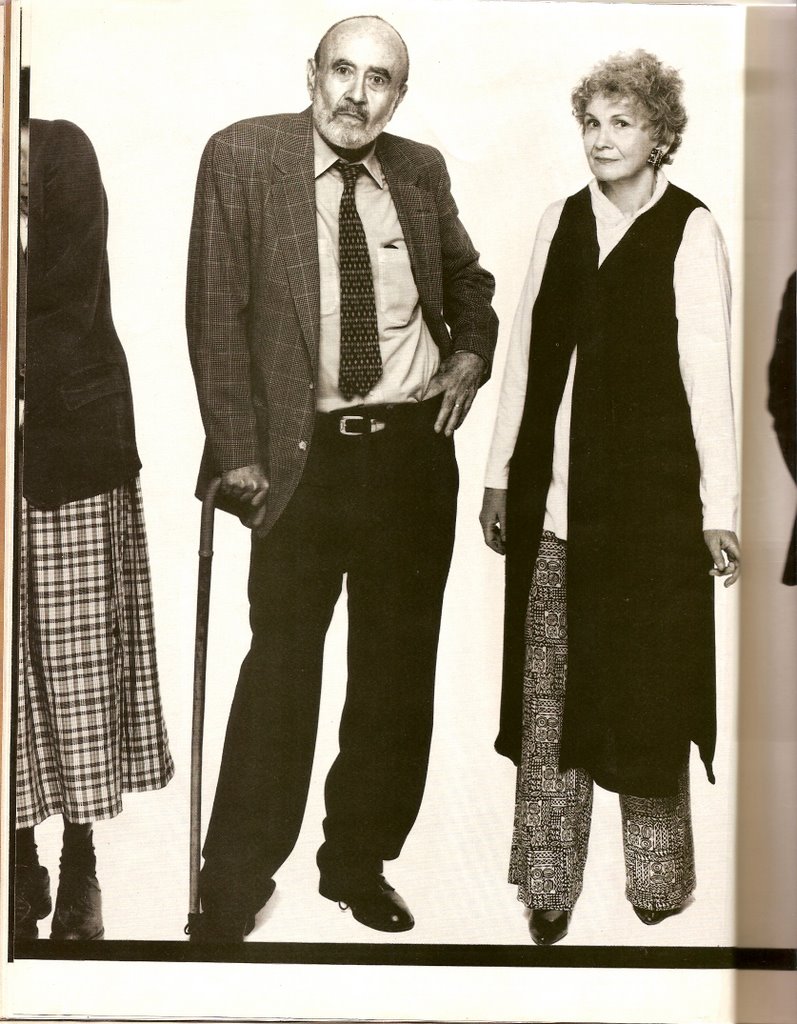
Richard Avedon Photographs Writers, 1994

Last month, when discussing Allegra Goodman's book Intuition, I mentioned how I was inspired and motivated to work on publishing my own poetry by a photograph from The New Yorker with Allegra standing next to JohnUpdike. I had cut the photo up and put it in the plastic cover of my writing binder for inspiration.

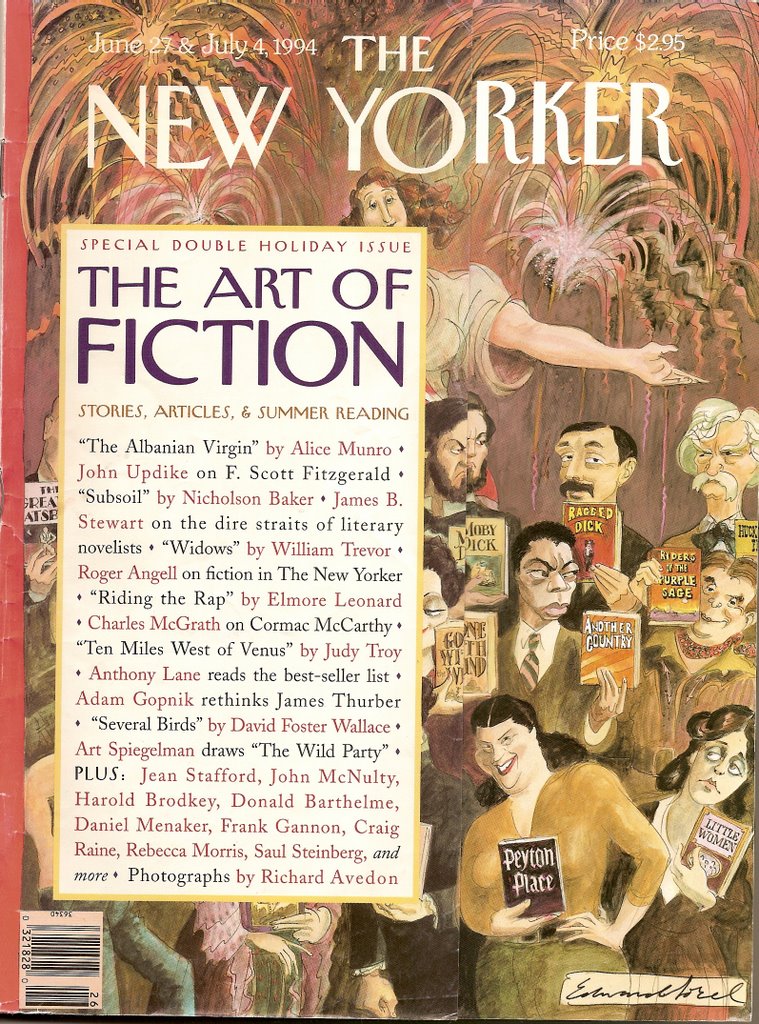
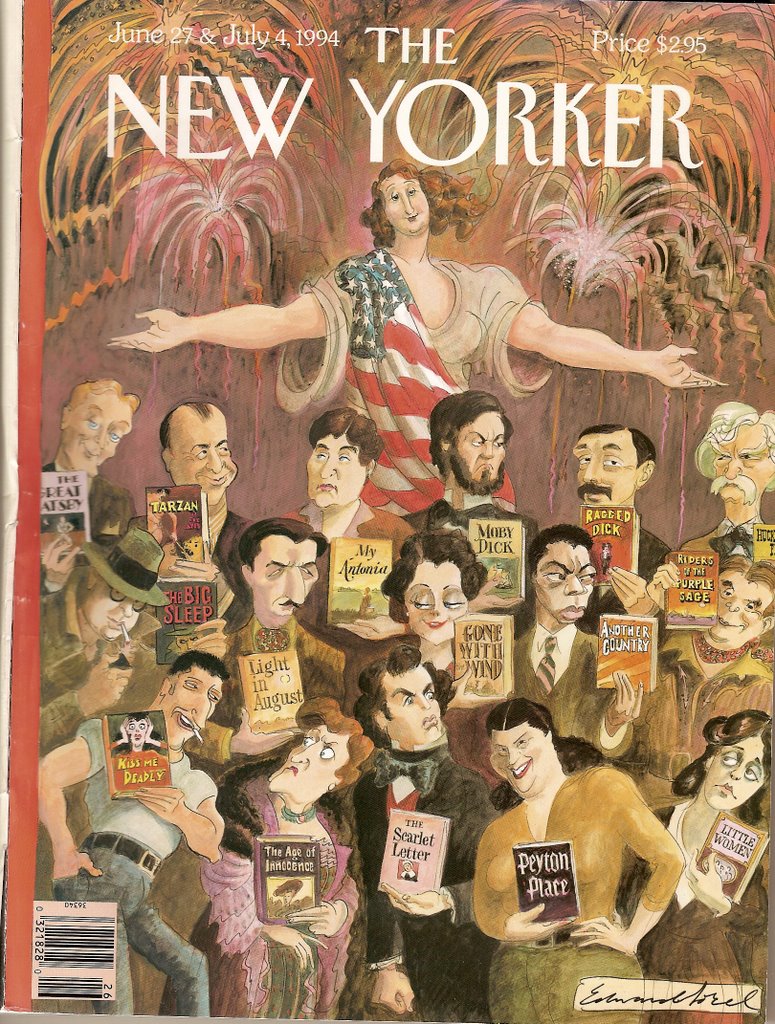
When discussing this, I thought it would be nice to find the photos again. I ended up finding a copy of the issue. On receiving it in the mail, I discovered that it was a familiar in more ways than one. The Edward Sorel cover is a classic which I had saved and hangs on our living room wall with several other New Yorker covers:


The magazine also had several other memorable pieces, including the first appearance of illustrator Art Spiegelman's interpretation of the poem by Joseph Moncure March's "The Wild Party". Look here to learn more about this amazing book.

Anyway, these photos don't appear to be anywhere else online. They may be in an Avedon book somewhere, but I haven't figured out where. So here, for your enjoyment, is the amazing "line-up" assembled by Mr. Avedon for The New Yorker.


That's Michael Chabon, and William Maxwell, who died in 2000.

Maxwell, Mavis Gallant, Bobbie Ann Mason, and Haruki Murakami long before attaining his huge popularity in the U.S.

Murakami, Ann Beattie, John Updike, and a sliver of Allegra Goodman.

Allegra Goodman, Nicholson Baker, Thom Jones, and Jamaica Kincaid.

Harold Brodkey (who died in 1996) and Alice Munro, a phenomenal short story writer.

Tom Drury and Edna O'Brien.

William Trevor, V.S. Pritchett (who passed in 1997) and Deborah Eisenberg.

Here's the accompanying text by Daniel Menaker, a staff writer with the magazine for twenty-six years. The text is a bit lengthy, but I have painstakingly retyped it here (probably in violation of some copyright laws) for your enjoyment. It's worth the read.

Last month, fourteen fiction writers closely associated with The New Yorker gathered in Manhattan to have their picture taken by our staff photographer, Richard Avedon, and then joined some of the magazine's editors for an on-location party. The event started at four o' clock in the afternoon and was over at about eight. Mr. Avedon sorted the fourteen into groups of four or five, and called these groups one at a time into a large, dark warehouselike room next to a smaller and brighter room, where the socializing took place. In the workroom was a stagelike platfrom, and each group sepent about thirty minutes being photographed there. Then it was back into the bright room. As the party progressed, the guest began to change seats, so that they could talk to old friends or to people they had never met before. And when the party finally broke up, some went over to the Algonquin Hotel for a nightcap, while others moved on to a party downtown.

At the beginning of June, Mr. Avedon travelled to London, to photograph three more fiction writers. This smaller gathering -a tea party, of sorts- took place in a rented studio in the Clapham section of London. The results of these two sessions are presented on the next seven pages.

We regeret that a number of writers couldn't join us, because of illness or previous plans, but the parties honored them, too. Both gatherings reminded us that writers do what they do not only to tell the rest of us what they see and what they know but to converse, implicitly, among themselves, and that, given the right circumstances, they will talk up a happy storm in person.

After the camera work was over, the participants in the Manhattan photo-op/party kept coming up with analogies for it. They are writers, after all, and they spend their days trying to flush out accurate correspondences. "It was like a combination dinner party and conference and school photo," Allegra Goodman said. John Updike said the photo session was "like a police lineup," and William Maxwell, describing the whole afternoon, weighed in with "Somewhere between a circus and a Commencement Day." Nicholson Baker said, "It seemed as if everything had just been whitewashed- it was so white that the whole gathering seemed afterworldly." And Michael Chabon, who, like Ms. Goodman, is young and currently of California, said, "It all reminded me of those comic-book-hero groups-- the Justice League of Amercia, or something. Of course, I was the Robin figure--Bucky the sidekick. Wait a minute, I'm getting D.C. comics mixed up with Marvel."

All the guests at this event agreed that it was a day to remmber. Alice Munro felt at home enough to take off her shoes. "They hurt," she said, "so I just took them off." She explained that she had worn those particular shoes "so I would look taller in the pictures." Jamaica Kincaid talked to Munro about a vase of flowers on a table. Together, they listed the horticultural names of the bouquet's components. Impressive. When John Updike saw Haruki Muramaki standing alone, he went over to him and ambassadorially commenced conversation by complimenting his work and testing the thesis that Murakami couldn't have flown in all the way from Japan. He hadn't. Cambridge.

Maxwell said of Thom Jones, "I knew that he had been a boxer and that his storeis were often about boxing, and my first good friend was a boxer, so I talked to him about boxers and asked if they fought because they were angry, hostile to the world. He said no, they were often gentle and frightened." Frightened of what? "Jones said that they're always afraid that they're going to get the shit beat of them in the ring." Ann Beattie found it funny, in a melancholy way, to hear that the two Canadians, Alice Munro and Mavis Gallant, recalling from their past stints as teachers the same kind of privations she herself had suffered more recently. "They both talked about having to buy their own phones for their offices," she said. "I guess it never changes." Bobbie Ann Mason was startled and flatterd to learn that Alice Munro and her husband had travelled through western Kentucky because they admired her work and wanted to see the region her stories describe. Tom Drury - along with nearly everyone else, it seemed- was delighted to meet Alice Munro at last; they have been carrying on a lively correspondence for months. Harold Brodkey admired the demanor of one of his fellow subjects. "How long have you been so happy?" he asked.

The setting was ur-New York---a place where the meatpacking districty and insdurty and Greenwich Village brownstones converge. Sun flooded in through tall windows. High spirits prevailed even on the platform in the cavernous photography room. "Allegra, would you mind putting your hand on John's arm?" Richard Avedon asked. "But we only just met," she said, with a giddy laugh. There were a fair number of giggles during the shoot, along with some schoolroom self-conscuiousness. Come to think of it, there was something close to a common denominator among the similes that the guests used for this part of the party, and that was the trope of the yearbook photo. Makes sense, because how often do you find yourself lined up and coached by a photographer? And what are writers of fiction if not people who can observe and respond to the world with youthful wonder and curiosity? The yearbook-photograph comparison brings to mind other staples of graduation, particularly what used to be called "Superlatives." What categoreis would one use here? Most Arresting Imagery? Best Characterization Through Dialogue? Cleverest Chronology? Funniest Names? Done Most for Genre? In any case, it's one hell of a class.

Wednesday, October 25, 2006

Best Magazine Covers of the Year

The Magazine Publishers of America have selected the "best covers of the year," the year being September 1, 2005 to August 31, 2006. Here are the winner and runners-up (click images to enlarge):
A classic politically-charged post-Katrina cover.

Second place:


Shayna has this on her wall.

Third place is scary-funny:


In the celebrity category, there was a two-way tie. One was Busta Rhymes on the cover of Vibe. Here's the other:


Any excuse to put Julianne Moore in BillyBlog, I'll take it.

The best news cover was also from the New Yorker:


Check out the site linked above to view all the winners and runners-up.