Showing posts with label Best American Poetry. Show all posts

Friday, September 26, 2008

The Best American Poetry 2008 Gala Reading at the New School

In years past, I have written detailed accounts of poetry readings that I have attended, thanks to some copious note-taking during the events.

This past Fall, I attended a Best American Poetry reading at The New School, on September 26, 2008. The event was to commemorate the publication of the 2008 edition, guest edited by Charles Wright.


Alas (and I do mean “alas”), composing a cohesive recap got away from me. Although I did post several of the videos that follow on YouTube [which are sadly in cyberlimbo, as the account has been "permanently disabled" due to some unspecified "copyright infringement" issue], I did not complete the following synopsis until January 2009. Unfortunately, the passing months surely diluted my memory of the event. Unlike many of my previous dispatches, this one is lacking in the mad scramble post-reading for poet signatures, which is always one of the things I love doing.

So, do bear with me as I wander back to September, when the financial crisis was still fresh news, and do my best to piece together the reading from my notes. It should be noted that a fresher, less-memory-gapped recap can be found here.


David Lehman, the Series Editor, welcomed us and gave his consummate introduction. He read Kathryn Starbuck’s “The Shoe” and his poem “On Humility”.

John Ashbery read his contribution to the volume, “Pavane pour Helen Twelvetrees,” and “A Worldly Country”.

Charles Bernstein followed with a hilarious take on the financial crisis entitled “Poetry Bailout Will Restore Confidence of Readers” [click to read].

My favorite part:

“Let there be no mistake: the fundamentals of our poetry are sound. The problem is not poetry but poems. The crisis has been precipitated by the escalation of poetry debt—poems that circulate in the market at an economic loss due to their difficulty, incompetence, or irrelevance.”


He then read from his book Girly Man, “The Ballad of the Girlie Man”.

Next up was Ciaran Berry reading the BAP-included poem Electrocuting an Elephant, which recalled a photograph from Coney Island, circa 1903. He also read another poem of his called “The Parsley Necklace” and followed with another poem from the volume, “Light” by C.K. Williams.

Next was Laura Cronk who read a poem entitled “Having Been Turned Down.” She also read “Entering,” her poem from the BAP volume. And she concluded with reading W.S. Merwin’s contribution, “A Letter to Su Tong P'o”. Special bonus: hear Merwin reading his own poem on NPR here (right click/save to download).


Richard Howard followed with his reading of the poem in the anthology “The Rape of the Daughters of Leucippus by Castor and Pollux”.


D. Nurske followed with his poem “The Gate of Abraham,” and Michael Palmer’s poem “The Classical Study (4)”.

Meghan O’Rourke, sporting nifty cowboy boots, started with Dean Young’s “No Forgiveness Ode.” She followed with her anthology poem, “The Window at Arles,” and another, which I believe was called “In Search of a Mission”.


Lee Upton wrapped things up by reading three of her own poems, including “Dyserotica,” “Omniscient Love,” and “Undid in the Land of Undone”. “Diserotica” ended with the wonderful lines “I know you don’t love me/but why do you have to brag about it?” The last poem was captured here:


She ended with reading Franz Wright’s “Passing Scenes (While Reading Basho)”


The reading ended, and I did my usual thing, scurrying about, collecting poet signatures in my multitude of anthologies. I didn’t catch everyone, but I was able to get autographs from most of the poets in attendance. As always, it was much appreciated, and I had a wonderful time. Once again, I would refer to the review by Kate Angus (referenced at the top of the post) as a complement to this recap.

Wednesday, July 09, 2008

Tom Disch, 1940-2008

Yesterday I noticed, on the Best American Poetry blog, there was a post announcing the death of the writer Tom Disch. Read it here. His obituary in the New York Times is here.

I mention this because, in my 11+ years in New York City, I have crossed paths with many writers and feel a certain pang when one of them leaves this world.

Here's an excerpt from my journal (back before blogging killed it) commemorating my meeting with Mr. Disch.

JAN 15 1999 8NPrince [on the N train between 8th Street and Prince] 5:40pm
Just spent a half hour chatting with the author/poet Tom Disch in a coffee
shop off of Union Square.

I had called him yesterday, out of the blue, asking him to sign books & he
agreed...[to meet me] this afternoon, after I got off of work.

I blaze out of work at 4:45 & make great time. We meet at 5, he asks about
me etc. & we talk about poetry & writing. Details?

He admired my "chutzpah" in calling out of the blue & asking him to sign.
Have I done this before? I mention Rachel [Wetzeon, who I had also
contacted previously and with whom I had met] & he seems surprised. In this
day and age, how do you know who to trust? etc. etc. "Well," I say, "the
worse thing that can happen is they say no." He corrects me: "Ah, not true.
The worst thing they can do is fall in love with you."

He doesn't like poetry readings, per se, & does them as favors.The money's
nice, but really they're drab, boring affairs.

He filled me in on some of his latest projects. And then, at 5:30, I bowed
out, & he was kind about it."

So that was that. I didn't record at the time that he did sign some books. In all, I have signatures from him in all 5 volumes of The Best American Poetry, in which he appeared, as well as a nice inscription in his 1997 book A Child's Garden of Grammar.

I don't recall ever seeing him again. Based on his comments about poetry readings, this is hardly surprising. I forgot about that comment he made which was really very funny: "the worst thing they can do is fall in love with you". Indeed.

Farewell, Mr. Disch, thank you for giving me a half hour of your time back in 1999.

Friday, February 08, 2008

Week End Wrap Up: Tattoos and Poetry

I thought about posting about this over on Tattoosday, but despite the congruent themes, I didn't want to start featuring tattoo subject matter that wasn't in line with what Tattoosday is all about, the spontaneous spotting of body art in New York City, and the stories behind the ink. That said, on Thursday, two tattoo-prominent models appeared in the New York media.

First, I spotted one of the free New York morning papers on the subway. The issue of Metro was actually overlayed with a "faux" cover which was really an advertisement, in this case, for Kenneth Cole. Here's the photo that graced the front cover:


The tattoos are spectacular. In fact, some people at work thought they were fake. But these are real and grace the body of Theo Kogan, lead vocalist from the Lunachicks (her MySpace profile is here). You can see this ad here, along with a video explaining how she fits into the Kenneth Cole "We All Walk in Different Shoes" campaign.

Similarly, The New York Times ran a story called "The Vanishing Point" on Thursday about the new "thin" male models. It is Fashion Week in New York, so this all makes sense. Anyway, one of the photos accompanying the article was this one:

The model on the left (with the tats) is Sascha Kooienga:

(Photo by Jon Malinowski)


I was hoping to get a shot of what appears to be a Miro tattoo on Kooienga's right side (in the Times photo), but no such luck.

And on a totally unrelated note, those readers of this blog know what a big fan I am of the Best American Poetry series. I discovered yesterday that David Lehman started a BAP blog, which is here (and hereinafter on the sidebar). The poet Denise Duhamel has a post entitled "The Politics of Erotica".

Tuesday, September 25, 2007

The Best American Poetry 2007 Reading at the New School


On Thursday evening, September 20, 2007, I completed my annual pilgrimage, a celebratory reading of the 2007 edition of the Best American Poetry series (hereinafter referred to affectionately as BAP).

In its 20th year, the BAP series is a fixture in the American Poetry scene. It is surely one of the better selling (if not the best-selling) poetry anthology series and, as a result, it is a lightning rod for criticism, both positive and negative. From the halls of academia (read Harold Bloom's introduction to the Best of the BAP here), to the blogosphere (this poet has seemingly never met a BAP he liked), the series always draws a crowd.

Politics and poetics aside, I love the series. I don't love every poem and I occasionally think, like probably every poet in America, that my best poems are better than some of the BAP inclusions. But these collections are snapshots, a potpourri of the best in the opinion of the editors. There has never been an awards ceremony, a top ten list, or a "best of..." collection in which everyone agreed with the selections.

My appreciation of the series is compounded by the compulsion I have for collecting it, and enhancing it with poets' signatures. The more the merrier. I started in 1997 with a volume signed by 4 poets. I now have 23 volumes (yes, a couple of duplicates) signed by approximately 160 different writers.

Yet, despite the line of books, like pretty maids all in a row, the core element is the reading itself, a celebration of the talent and diversity of the year's volume.

A little disclosure: at the end of the event, during the signing, when I had series editor David Lehman sign the new edition. I mentioned my e-mail to him earlier in the day and he remembered me. And I mentioned how I had the whole run of the series. He looked at me and said "Oh, yes, I think I read your blog."

My heart raced. "From last year's reading?" I offered. "Yes," he said, "someone sent me the link." In last year's post (here), I spoke affectionately about the series. I also blogged it in 2005 Somewhere (I can't find it) I posted a photo of my ever-lengthening row of BAPs. I told him that I'll be bogging the event this year as well. He seemed pleased. "I don't normally read blogs," he said, and I understand why, some people are not so nice, to put it mildly. Mr. Lehman, however, was inclined favorably to BillyBlog.

Keep in mind, dear readers, that I generally am positive about things in BillyBlog, and I am rarely critical. I am of the school of "better to say nothing, than say anything bad". If this report seems gushy and warm and fuzzy, it is because I am a fan of the series, and not because I am worried that Mr. Lehman might be reading this.

The reading started a little late (5 minutes) and I was perched in my favorite seat (C-1) in Tischman auditorium, at the New School.

David Lehman spoke first, and talked briefly about the series and made a surprise announcement that elicited an audible gasp! from the audience. Well, it wasn't really a surprise announcement, just fresh news. The New York Times had reported that day that Alice Quinn, poetry editor for The New Yorker for 2 decades, had stepped down and was being replaced by BAP '05 editor Paul Muldoon. Lehman than spoke a little about this year's anthology and announced that the reading format would be a little different this year.

He stated that first, seven local New York contributors would read, in alphabetical order. Aside from Matthea Harvey and Elaine Equi, they were all in their first BAPs. Then, Lehman continued, the three poets who had traveled the furthest (and are, by far, the most established as writers), would read for 20 minutes each. This trio was the guest editor Heather McHugh, Alan Shapiro and former Poet Laureate Robert Pinsky.

The reading began with Kazim Ali (pictured, left) reading The Art of Breathing.

He was followed by MacGregor Card, reading Duties of an English Foreign Secretary: "Moon, refrigerate the weeping child / and guard his frozen brook."

Next was Sharon Dolin (pictured, right) reading Tea Lay.


She was followed by Elaine Equi (pictured, left), reading Etudes.


Next came Thomas Fink (right), performing Yinglish Strophes IX (viewable on page 25 in this online publication).

Then, Matthea Harvey (left) reading From The Future of Terror/Terror of the Future Series. ("From the gable of the window, we shot / at what was left: gargoyles and garden gnomes.")

And last of the seven, Meghan O'Rourke, reading Peep Show. BillyBlog is proud to offer some video this year!


Read Peep Show and several other poems here.

After O'Rourke, David Lehman returned to the stage and spoke briefly about the "big three" poets remaining. McHugh started things off with a funny introduction and then, based on Lehman's insistance, read No Sex for Priests, which she had scribbled on the back of a manila folder, lacking any of her own material in her possession.

NO SEX FOR PRIESTS

The horse in harness suffers;

he's not feeling up to snuff.

The feeler's sensate but the cook

pronounces lobsters tough.

The chain's too short: The dog's at pains

to reach a sheaf of shade. One half a squirrel's whirling there

upon the interstate. That rough around

the monkey's eye is cancer. Only God's

impervious—he's deaf and blind. But he's

not dumb: to answer for it all, his spokesmen

aren't allowed to come.


She followed this with a brief discusion about the enjoyment involved in editing the anthology. Then she read several selections from other poets in the anthology:

Christian Bok: Vowels
Matthew Byrne: Let Me Count the Ways
Robert Creeley: Valentine for You
Charles Harper Webb: Big
Marya Rosenberg: If I Tell You You're Beautiful, Will You Report Me?: A West Point Haiku Series

McHugh finished with her recitation of Richard Wilbur's From Opposites and More Opposites (video below).


Next up was Alan Shapiro who, despite being in his sixth volume of the BAP, I had never heard read before. He announced that he would be reading from a forthcoming volume called Old War, which I would link here, but I can't find any references to it, per se.

Shapiro was excellent, a treat to hear for the first time. I regret only that I captured one of his more serious poems (on video below), as opposed to one of the more humorous pieces that he read.

He started with Eggrolls, a poem that contained a line that he had struggled for "30 years to get ... into a poem" and finally managed to do so.

Here's a bit more about the poem from an online journal called Blackbird:

I overheard a remark in a Chinese restaurant many years ago...I had overheard somebody say this line...thirty years ago, and I always wanted to get it into a poem and couldn't figure out to do it for years and years, and in fact, it had been in different poems that weren't very good. Then I finally found a place for it. I think that's all you need to know. It's called "Eggrolls," and it's about a couple overhearing another couple having a little marital spat.

["Eggrolls" by Alan Shapiro, from Tantalus in Love, published 2005 by Houghton Mifflin.]


Listen: hear him read Eggrolls here (mp3), from a reading at George Mason University on September 15, 2005.

Next he read "Old War," explained further in another excerpt from Blackbird:

In the early seventies, I went to Dublin when I graduated college, and my trip there...coincided with the last terrorist bomb to go off in Dublin, and it's unclear even today whether it was the IRA, or the British who were setting up the IRA, who set off the bomb, but it went off near the Trinity library...and the windows shattered...the poem is inspired by that memory which was occasioned by our justifiable preoccupation with terrorism today, and, again, in a way, it's a poem about what is the place of poetry, a kind of safety and beauty and projection of a kind of civilized mental posture that poetry both, that is the soul of poetry. What place does it have in a world of dirty bombs and dirty politicians?


Another serious poem followed, called Night: "Night of the empty city/My brother eight years dead..."

He followed this with poem After (video below)


This was followed by Country Western Singer, a very funny poem that was his contribution to this year's BAP.

Next was Misjudged Fly Ball, from BAP '06 and now, Shapiro informed us, renamed Outfielder.

He ended with a poem called Open Mic Night in Heaven.

The last poet of the evening was Robert Pinsky. He began by reading Poem of Disconnected Parts. The poem originally appeared in the February 2006 issue of Poetry, and is the first poem in his new book Gulf Music, due out next month (see Amazon link at the end of this post to order).

He followed with The Forgetting, viewable in the clip below.


He followed with both of his poems from BAP '07: Stupid Meditation on Peace and Louie Louie. Next was Immature Song (buried with some other poems here).

Next was a short poem called XYZ:

The cross the fork the zigzag—a few straight lines
For pain, quandary and evasion, the last of signs.


And he finished with From the Last Canto of Paradiso, which is the last poem in his new book.

Normally I give a run down of my scramble for autographs in my BAP anthologies, but it has taken me several days to compose this, so I will summarize. Of all the readers, I was able to get signatures from 10 of the 11 poets. Meghan O'Rourke eluded me. Well, not really. She just left when I was busy with everyone else. I obtained 10 signatures in the BAP '07, amd 15 additional signatures in 12 other anthologies (all BAP's, except for the Pinsky-edited The Handbook of Heartbreak, a fabulous little book. Shapiro signed 7 books, Pinsky 5, McHugh 3. I had one paperback anthology with me (Poetry Daily) which I avoided altogether, and a paperback of a John Ashbery volume, just in case he had shown up.

Everyone was courteous and friendly. Pinsky asked me if I was a dealer or a collector. I truthfully confessed my mania for anthologies. The conversation with David Lehman (mentioned at the beginning of the post) was the high point for me. Very few other anecdotes to relate.

Additional BAP '07 chatter on the web:

Whimsyland tells you "All About BAP"

Moondoggy's Pad reviews it here. And links a review in the Seattle Times.

Some titles mentioned here....


Thursday, June 21, 2007

Poetry Quote o' the Day

Getting a poet to talk about his or her poem is like trying to get a dog to look into a mirror; no matter how well-groomed the poodle, these creatures prefer the smell of something real to their own scentless reflections.

--Billy Collins, in the introduction to Best American Poetry 2006


I like the quote, but how does that explain this?

Friday, May 18, 2007

A Look Back: David Lehman's Best American Poetry Series Appeals to Rock Stars

In the course of looking through some old e-mails, I came across a blurb that I had sent someone about the Best American Poetry Series, edited by David Lehman. Read on:

From the January 8, 1999 issue of Entertainment Weekly:

Meter Reader A few months ago, Scribner editor Jake Morissey received an unusual request: Bruce Springsteen, a huge fan of the popular Best American Poetry anthology series, had been unable to find the first six books (1988-93); could Scribner supply him with the missing volumes? Members of Springsteen's staff had searched for the out-of-print volumes with no luck. Morrissey forwarded the Boss' request to Gillian Blake, the editor who oversees Best American. "I had a few on my shelves," she says. "David Lehman, founder and series editor of BAP, supplied his own copy of the very rare first volume, edited by John Ashbery." Blake hasn't yet heard back from Springsteen, but she learned from the intermediary who contacted Scribner that the singer was "very pleased and grateful". --Clarissa Cruz and Carmela Ciuraru

Well, needless to say, I was pleased as punch to read this, and even more pleased to know that like Bruce Springsteen, I had a full run of the series, all in hardcover, including the "very rare first volume". Plus, mine are all signed, on average, by at least twenty of the contributors and editors (my 2006 edition only has 10 autographs, but my 1998 edition is signed by 35!). Truly a one-of-a-kind collection, one that I would venture to say, The Boss would admire.

I'm guessing Mr. Lehman's collection would be the only one more impressive, assuming he found a replacement for the '88 edition which he so kindly gave to Springsteen. As for their commercial value, it is difficult to say, as many of the poets have inscribed their contribution pages to me, and the person willing to plunk down a boatload of money on poetry books doesn't necessarily want copies inscribed to someone else, not even an amateur blogger/poet/H.R. dude.

Tuesday, April 17, 2007

Tuesday Menagerie

I came across another blog, Nerd Litter, that posted (via a guest poster) about last month's Lucinda Williams concert at Radio City Music Hall. Read it here. It's a nice complement to my review here.

Micah alerted me to a recent review by Charles Simic of Zbigniew Herbert's Collected Poems in The New York Review of Books here. Oh. Just realized, the full review is only available to subscribers. Micah must be a subscriber because he excerpted one of Herbert's poems, which I will share here:


Report from Paradise:

In paradise the work week is fixed
at thirty hours
salaries are higher prices steadily
go down
manual labour is not tiring
(because of reduced gravity)
chopping wood is no harder than
typing
the social system is stable and the
rulers are wise
really in paradise one is better off
than in whatever country


At first it was to have been different
luminous circles choirs and
degrees of abstraction
but they were not able to separate
exactly
the soul from the flesh and so it
would come here
with a drop of fat a thread of
muscle
it was necessary to face the
consequences
to mix a grain of the absolute with
a grain of clay
one more departure from doctrine
the last departure
only John foresaw it: you will be
resurrected in the flesh

not many behold God
he is only for those of 100 per
cent pneuma
the rest listen to communiques
about miracles and floods
some day God will be seen by all
when it will happens nobody
knows

As it is now every Saturday at
noon
sirens sweetly bellow]
and from the factories go the
heavenly proletarians
awkwardly under their arms they
carry their wings like violins

(Trs. by Milosz and Scott from The Collected Works of Zbigniew Herbert; The New York Review of Books April 26, 2007)


Yesterday, the Pulitzer Prizes were announced.


Cormac McCarthy has won the Pulitzer Prize for Literature, and Natasha Trethewey has won for poetry.


New York Times article here.

I am fiddling with the good folks at Amazon, as I continue to sell out.


Friday, April 13, 2007

Visiting Langston and some other stuff

I'm a sucker for thirft shops and used book stores. People who know me know that. My Vonnegut post that is forthcoming will explain the origins of my bibliophilia a little more. My catalog of books and journals (the organized spreadsheet I have of my "inventory") contains over 700 titles.

And when I see books that jump out at me, including children's titles, I am tempted to get them.
For example, this past Monday, I found this title at our local Salvation Army:


Now, I recognize the name of Willie Perdomo as a poet, and I am always interested in the work of poets, outside the scope of poetry, so I checked it out.

It's a nice little book. From Publisher's Weekly:

Perdomo (Where a Nickel Costs a Dime) captures the excitement of an African-American girl anticipating a visit to the Harlem brownstone of Langston Hughes. The narrator, an aspiring writer, expresses her enthusiasm from the opening lines: "Today I'm going to wear/ My favorite pink blouse/ I'm going with my daddy/ To visit Langston's house." Throughout, Collier's (Uptown) heady blend of watercolor and mixed media collage evokes the history of the writer's life and times. In the opening spread, a black-and-white painting depicting Jazz Era scenes hangs on the wall as the girl sits smiling on a couch, clutching a notebook and pen. In a kind of meditation on the poet, subsequent spreads incorporate elements of that painting, which hangs in the girl's living room: for instance, bass players and a pianist inhabit the space behind Langston at his typewriter ("Langston/ Langston/ Langston Hughes/ Wrote poems/ Like jazz"). Collier then shows the girl kneeling to read the paper in Hughes's typewriter. In the end, Perdomo adds a twist: the girl and her father stand before the doors of Langston's house and the opening lines repeat; she sits on the couch in the next spread but, this time, her notebook is open. "Langston/ Langston," says the girl. "I write poetry/ Just like Langston Hughes." Is she writing about the trip she just made? Or is she imagining the visit to come?

Check out book details, including other images from within the book, here.

Anyway, aside from being a nice book, the front endpaper had a little surprise for me:


That's signed by both Perdomo, and the illustrator, Bryan Collier. Not that I'm thinking of selling it, but ABE Books lists 8 copies for sale, only one of which is double-signed. The going rate (admittedly inflated for the marketplace) is $85. Not bad for a book I paid $2.99 for, no? Plus, it's a pretty little book.

In other book news, I hit a book sale room at the Mid-Manhattan Library today and snagged the following:


and

Latin American Literary Review, Volume XIII, January-June, 1985, Number 25, The "Gabriel Garcia Marquez Issue".

Saturday, October 28, 2006

Academy of American Poets Fifth Annual Chancellor's Reading

On Thursday, October 26, I attended my first Chancellor's Reading of the Academy of American Poets. I'm always a sucker for events featuring multiple poets, so this was quite a treat. Jill, Friend of BillyBlog, joined me for the event which was held at the Kaye Playhouse at Hunter College at East 68th Street in Manhattan.

Tree Swenson provided a brief introduction. She advised that Philip Levine had to cancel at the last minute, and that we were going in reverse alphabetical order. Then, the following poets/chancellors took the stage: Rita Dove, Frank Bidart, Gerald Stern, Kay Ryan, Galway Kinnell, Nathaniel Mackey and Ellen Bryant Voigt.
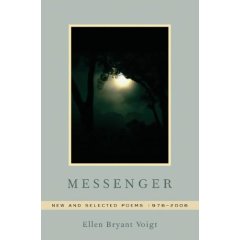
The reading started with Ellen Bryant Voigt. I'm not a huge fan of hers and her reading was not very memorable. She read several sections from a long poem, the title poem "Messenger," from her upcoming collection of poems, due out from Norton in January 2007.

Perhaps it was the woman in front of me, thickening the air with Calvin Klein Obsession or the muttering poet/professor who sat behind me prior to the reading talking about how great he was, but I was distracted to the point that Ms. Voigt's reading fell flat for me. Perhaps I just don't have the werewithal to tune into longer poems at a reading. Who knows? Moving on . . .
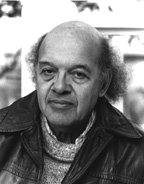
Next up was Gerald Stern, who I have had the pleasure of hearing read numerous times. He graced us first with a poem by Philip Levine. He read "My Given Name" from Levine's last collection Breath.

Then he read four poems, "two short, two a little longer." The first was called "Shouldering" from his collection Everything is Burning. Next was "You Know I Know," a poem he had written about talking to a Korean War veteran in Washington D.C., while waiting to change trains "from one form of fuel to a more stupid form of fuel." He ended with a funny little poem about a chihuahua called "Save the Last Dance for Me."

Stern was followed by Kay Ryan, a poet I had only recently become familiar with. I had heard her read a bit from a podcast (mp3 here) in which she is dicussing poetry with Billy Collins and Garrison Keillor. She started with a piece called "Home to Roost":


Home to Roost

The chickens
Are circling and
Blotting out the
Day. The sun is
bright, but the
chickens are in
the way. Yes,
the sky is dark
with chickens,
dense with them.
They turn and
then they turn
again. These
are the chickens
you let loose
one at a time
and small-
various breeds.
Now they have
Come home
To roost -all
The same kind
At the same speed.
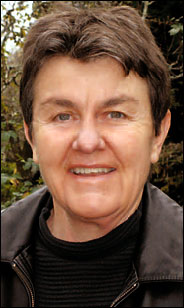

Her next poem was based on a brief vision she had had, in which everyone was carrying a ladder. It was called "A Visionary Poem." Jill remarked after the reading that she didn't initially like Ms. Ryan's poems, but they grew on her. I would concur. She uses internal rhyming and assonance to a high degree of perfection. It is quite moving, and pleasing to listen to her read.

She then read a poem called "Tired Blood," which was in her last book The Niagara River: Poems. In the New York Times, last December, David Kirby reviewed the book and, referring to "Tired Blood," stated "often her images are deliberately unlovely: silences are embedded in a noisy city like shark's teeth, a tired person's blood is cruddy with tiny metal office furniture." She paused after one line, mid-poem, and glowed: "It gave me great satisfaction to say painful cabinets."

She then read the title poem to The Niagara River, then talked about malapropisms (like "Leap before you look") and their role in the next poem, "Green Behind the Ears". She followed with "Atlas," which David Yezzi discussed in The Weekly Standard:

Occasionally, Ryan's serendipitous rhymes and tightly turned ruminations approach a kind of light verse, sporting an against-the-grain delight in wit and a rare confidence that humor needn't cancel the truth in a poem. "Atlas," for example, tickles the reader while shrewdly identifying a palpable human experience:


Extreme exertion isolates a person from help, discovered Atlas. Once a certain shoulder-to-burden ratio collapses, there is so little others can do: they can't lend a hand with Brazil and not stand on Peru.


Her poem "Shipwreck" began with an epigraph that is well worth repeating here:

I was shipwrecked beneath a stormless sky
in a sea shallow enough to stand up in.

— Fernando Pessoa

Think about that for a minute. Such an evocative image. You can read Ryan's poem here. If you've been looking, you'll notice her poems are short and concise, which is why we received so many at the reading. She ended with "Weak Forces".
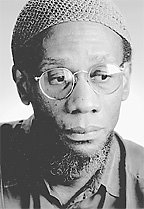
Next up was Nathaniel Mackey. Like Ryan, this was the first time I had heard him read. He read sections from an ongoing series of poems called "Song of the Andoumboulou". Poems #21 and #50 (not necessarily the ones he read) can be accessed by clicking the link above. Unfortunately, the length of the reading did not support a better appreciation of this work. However, there was some great imagery within his work.
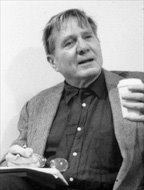


Next up was Galway Kinnell, who is always a pleasure to hear. He started with "Middle Path: In Memory of James Wright 1927-1980," which referred to the Middle Path walkway that separated the quad at Kenyon College where James Wright taught. He then read "The Dinner Party," reprinted in full here. Kinnell described this as a narrative with a divided speaker. on one hand he is looking for pleasure, on the other hand he is feeling obliged to go to work.
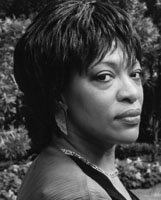

Kinnell was followed by former U.S. Poet Laureate Rita Dove. She read a series of several poems that deal with visual artists, "each positioned at a moment of historic flux in different cities." Portions of what she read appear here, under the title "Brightening" in The Virginia Quarterly Review. She presented the following part under the title "Paris":

I want only the paint:
swirled ridges, crusts of pigment
curling off the lip of the knife.
I want my life to be
the story of paint, concrete color:
a flying fish so orange, it's a medallion
cast into ashes. Now I will stop biting
my cuticles and my back will stop aching
so I can paint until the sun comes up;
then I'll take a cup of sherry to bed
to calm down. I want to lick the canvas,
grow buoyant on turpentine, make love
to every year between eighteen and twenty-five
and paint each in its own color—
reddening branch, emerald caduceus of leaves
traveling fast over the garden wall.
I want the cerise of the poisoned berry
and the blue eel and the gray of the pebble
you must moisten with your tongue
to bring out its platinum sheen.
I want you to be that pebble.
I want to put you in my mouth.

She followed with a poem for Elisabeth Schwartzkopf, the famous German opera singer, and ended with a marvelous poem called "Reunion 2005". I wish I could find it online. Alas, all I scribbled down was the line "My Cleveland cousins/have everyone speaking/Southern."
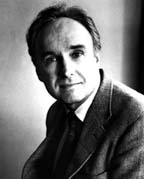
The reading concluded with Frank Bidart. He started with a poem called "To the Republic," which he had read last year at the same event, only he added three more lines. According to a site called Republic Blog News, he read the same poem earlier this month at Wesleyan and

The audience responded particularly well to "The Republic," a poem inspired by a bad dream. In the poem, Bidart describes the bodies of exhumed Gettysburg soldiers. The poem had powerful political connotations.

"It is about the idea that this government is ruining what the United States stood for in the world," Bidart said. "If it's any good, it will not just be an anti-Bush poem, but be about the past coming and saying that you've betrayed the legacy we left here."


The poem is reprinted here on a blog called Just Between Strangers.

Next was "Poem Ending with Three Lines from 'Home on the Range' ". You can read it here in Slate. You can also hear Bidart read it here. He ended with a sestina entitled "If See No End in Is," which Bidart said was his "first sestina and, I assure you, my last."

I know, I know. This was long. (I'm not done yet). But after reading on another person's blog that my recap of the Best American Poetry launch was "pedestrian," I feel I have a reputation to maintain.

After the reading, I went to work getting books signed. Gerald Stern and Galway Kinnell sat at a table. Rita Dove was behind them standing by a window ledge. Frank Bidart, Nathaniel Mackey and Kay Ryan were mingling. Ellen Bryan Voigt disappeared early.

Ms. Dove graciously signed under her photograph in a book called Angels, Anarchists & Gods. She also signed her contributions in The Best American Poetry (BAP) volumes for 2003 and 2004.

Nathaniel Mackey elaborately signed his pages in BAP '88, '90, '02 and '04.

When Kay Ryan saw me standing next to her holding my copies of BAP '95, the Best of the BAP 1988-1997, BAP '99, and First Loves: Poets Introduce the Essential Poems That Captivated and Inspired Them, she looked at me and said, "Oh, you're one of those." I looked at her and asked is that a "good" "one of those" or a "bad" "one of those," she said good and warmed up when she realized I was a collector and not a dealer. She signed what I had.

Frank Bidart signed his page in Robert Pinsky's The Handbook of Heartbreak: 101 Poems of Lost Love and Sorrow and inscribed a hardcover copy of his first book Golden State. We talked briefly about how great New York City was for readings and how it blew Southern California out of the water. He had grown up in Bakersfield and spent many years at UC Riverside, so we chatted briefly about Pasadena and my alma mater, Occidental College.

I then went back and caught Galway Kinnell before as he was leaving. He signed his page in BAP '05 and then I had an unusal request. I already had an inscribed copy of C.K. Williams' The Singing. After asking nicely, and showing that Mr. Williams had already inscribed it to me on the title page, Mr. Kinnell inscribed the dedication page, as he was the dedicatee. This made my copy a little more unusual and that much more pleasurable to me.

I missed Gerald Stern and Ellen Bryant Voigt completely. Oh well.

Thanks for enduring this post. Comments are appreciated.


Friday, December 05, 2003

From the Archives, P.S.A. Chapbook Reading, December 5, 2003

This is part of my "From the Archives" series, which consists of texts from e-mails I sent to friends describing my experiences at poetry events. I may have taken some small editorial liberties with these texts, and I have included related pictures and hyperlinks, but these are all BBB (Before BillyBlog). Remember, for me readings are enjoyable for two separate reasons: the love of poetry, and the mania for collecting. I am who I am. Enjoy!

The following is the text of an e-mail to two friends about the Poetry Society of America's inaugural reading for its first Chapbook Contest winners, in which the winners read with the judges who selected their work.

Subject: PSA reading
Date: Fri, 05 Dec 2003

Good day gents:

Last night I attended:

Poetry Society of America Chapbook Reading
The Poetry Society of America presents a poetry reading of this year's prize-winning chapbooks with the winners, Paul Killebrew, Dawn Lundy Martin, Tess Taylor, Kerri Webster (bios of the four winners here), and the judges, John Ashbery, Eavan Boland, Carl Philips, and C.D. Wright.

It was a groovy reading.

First Ashbery read from Chinese Whispers, the introduced Killebrew who was good, read from his chap [entitled Forget Rita], then a poem called "John Fuckin' Ashbery" that went over well. Then Eavan Boland read. She stunk. Irish Potato Famine. Big deal. Way too serious.

[Note from the future: I'm guessing I was a bit too harsh on Ms. Boland at the time. However, these were my thoughts shortly after the event. I didn't want to self-censor myself here, although my lack of any constructive criticism is telling, for sure.]

Then Tess Taylor. She was mediocre and rather overdramatic.

[Again, perhaps my demeanor was tainted by these poets' successes vis-a-vis my relative lack of accomplishment.]

Then Carl Phillips, best of the established poets.

[Another interjection, the poetry establishment, I'm sure, would object to Phillips being regarded as better than John Ashbery, who is poetic royalty. Even I, in retrospect, raise my eyebrows at this statement.]

He was funny, ending with a hilarious homoerotic poem about cowboys. His poet Kerri Webster was very good with a series of poems loosely based on Joseph Cornell's work. Finally C.D. Wright, who was forgettable and her choice Dawn Lundy Martin, a short-haired African-American young woman whose sexual imagery was too violent and stark for my liking.

[Another interjection from the future. I'm a bit disappointed in my recollection of the reading. As you will see when I post the 2004 and 2005 recaps later on --sadly, I missed the 2006 event--I was still a bit short-sighted when it came to appreciating a good evaluation of these readings. My apologies to any of the poets who may be off-put by my retroactive dismissal of their work. This year, it seemed, I was more about the signing afterwards, than the reading itself.]

The reception was chaos. I pounced on Ashbery who signed Wakefulness, Girls on the Run and And the Stars Were Shining. Then I got Boland to sign her contributions in the Pinsky-edited America's Favorite Poems and my anthology First Loves: Poets Introduce the Essential Poems That Captivated and Inspired Them. Then I nabbed Carl Phillips, who was very flirty with me as we talked about the National Book Award reading I saw him at a few years back. He signed his contribution [the poem "A Mathematics of Breathing"] in The Best of the Best American Poetry, and his pages [the poem "Alba: Innocence"] in the volume of Ploughshares guest edited by Yusef Komunyakaa and [the poem "Of That City, the Heart"] in The Paris Review (#148, Fall 1998). I thanked him for signing them and told my J.D.McClatchy story about his empathizing with my mania for obssessive collecting. Phillips recalled a story McClatchy tells about how, as a young poet, J.D. asked W.H. Auden to sign a book and Auden had J.D. turn his back and used his back as a table to lean the book against.

I then went out to the foyer for a glass of wine. There I got C.D. Wright to sign her entries in Pinsky's The Handbook of Heartbreak: 101 Poems of Lost Love and Sorrow, my NEA Writing America booklet (now signed by poets from 12 of the 50 states, one of my favorite items) and above Ferlinghetti in my United States of Poetry book. Wright was kind of cold and dismissive.

Then I spotted David Lehman and had him sign my Best American Poetry 2002. I had my printout (23 pages) listing all the items I had with me and every poet appearing in them. It came in handy, but alas, Vijay Seshadri and Marie Ponsot had already signed what I had with them as contributors. I did also get Alice Quinn, The New Yorker poetry editor to sign her forward in First Loves. We chatted about the project. How the editor [Carmela Ciuraru] had asked several poets to write the intro, but they all wanted to contribute instead (it's a book with poets introducing poems that inspired them as young writers), so Alice ended up writing the forward. She recommended, if I liked this book, which I do, to check out something Richard Howard did with the poems of Elizabeth Bishop. But I can't seem to find it on the net (the title eludes me and I can't track it down). More later. [I later grabbed a copy online, it is called Preferences: 51 American Poets Choose Poems From Their Own Work and From the Past (1974).]

Anyway, I caught John Ashbery again and had him sign my friend Brian's Strand anthology [The Contemporary American Poets] (merry holidays!) and then went back to good old Carl and had him sign 3 more Best American Poetry volumes, flirting shamelessly. Yes, boys, I've resorted to whoring myself for signatures.

In addition, I purchased the 4 chapbooks ($20 for the set, nice little "first book" items) by the new poets, all of which I got inscribed.

Totals for the night: 10 poets, 21 signatures.

Plus, I hit 12th Street Books before the reading and found a nice hardcover copy of e.e. cummings' 95 Poems ($7.95) and a 1st edition of Sandra Cisneros' Loose Woman ($5.00).

Not a bad night,

Bill

p.s. Doppelganger was there. Baseball hat. No leg cast.